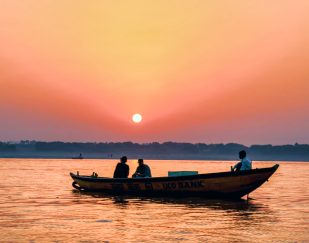
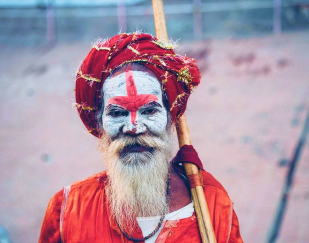
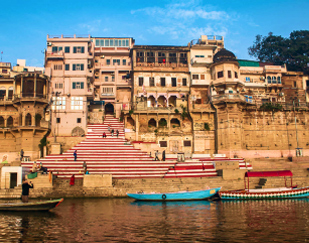
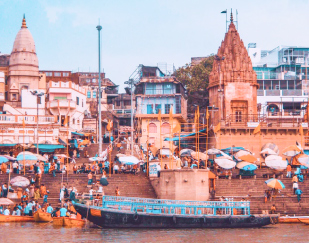
Any exploration of Varanasi must begin with its profound spiritual gravitas. Poised along the eternal banks of the River Ganga, the city unfolds as a living shrine, its labyrinthine lanes and riverfront ghats adorned with nearly 3,000 temples, earning it the revered title of the City of Temples.
Among its most singular sanctuaries is the Bharat Mata Mandir, a temple devoted not to a deity, but to the essence of Mother India herself. Instead of idols, a meticulously carved marble map of pre independence, undivided India takes centre stage. On Republic Day and Independence Day, the landmass is lavishly carpeted with flowers, transforming the space into a moving tribute to the nation. The inaugural poem penned by celebrated poet Maithili Sharan Gupt remains inscribed within the temple, lending it literary as well as patriotic distinction.
Equally significant is the Sankat Mochan Mandir, dedicated to Lord Hanuman and envisioned by freedom fighter Madan Mohan Malviya. Devotees throng this temple in the belief that prayers here ease life’s troubles. Nearby, the Sankata Devi Temple, believed to be the only shrine in India dedicated to Devi Sankata, comes alive on the eighth day of Navratri, when the Goddess is worshipped with ceremonial splendour. The Annapoorna Devi Mandir, another spiritual cornerstone, draws countless worshippers annually and glows resplendently during the Annakoot Festival, when sacred coins distributed to devotees are said to usher in prosperity.
Towering above all in sanctity is the Kashi Vishwanath Temple, one of the twelve sacred jyotirlingas of Lord Shiva. Revered in the ancient Puranas, this shrine draws devotees throughout the year, but during Maha Shivratri, its celebrations reach a crescendo of colour, devotion and divine energy that leaves visitors awestruck.
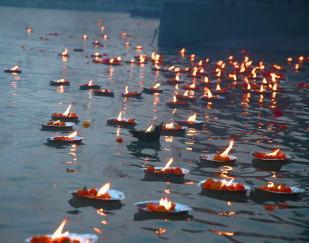
As dusk descends, the ghats transform into a theatre of devotion during the spellbinding Ganga Aarti. Priests perform synchronised rituals accompanied by chants, conch shells and flickering flames, as illuminated lamps shimmer against the flowing waters of the sacred river. The scene, solemn, luminous and deeply moving, has become an essential experience on every Varanasi itinerary.
Beyond Hinduism, the city’s spiritual embrace extends to other faiths. Just ten kilometres away lies Sarnath, where Lord Buddha delivered his first sermon after attaining enlightenment, making it one of Buddhism’s holiest sites. Jain pilgrims too hold Varanasi dear, as four Tirthankaras, including Parasnath, were born here. Their temples stand as quiet testaments to the city’s plural spiritual heritage.
It is often said that every lane in Varanasi shelters a temple, weaving an invisible yet powerful tapestry of faith across the city. Pilgrims arrive seeking liberation, solace and renewal, while even the casual observer is invariably stirred by the devotion that permeates the air, a timeless rhythm of belief that transcends the ordinary.
Echoes of an ancient past
Varanasi is widely regarded as one of the world’s oldest continuously inhabited cities, with some accounts tracing its origins back to the era of the Indus Valley Civilization. Its legacy is immortalised in Hindu scriptures such as the Puranas and in the epic Mahabharata. It is also believed that the poet saint Tulsidas composed the Ram Charit Manas along these sacred riverbanks.
The city’s royal and strategic past is embodied in its forts. The Ramnagar Fort, still home to the Royal Family of Kashi, stands as a stately reminder of princely India. Part palace, part museum, it houses rare artefacts of the Maharajas, including a gold cast palanquin, African weaponry and evocative royal portraits.
Equally compelling is the Chunar Fort, whose strategic importance made it a coveted stronghold for the Guptas, Mauryas, Mughals and the British alike. The fort owes its prominence to the famed Chunar stone, prized for its durability and used extensively in historic forts, palaces and idols. Within its walls lie intriguing features such as ancient step wells, the Bawan Khambo Ki Chattri, erected by King Mahadeo to honour his daughter Sonwa’s victory over 52 rulers, and the former residence of Warren Hastings.
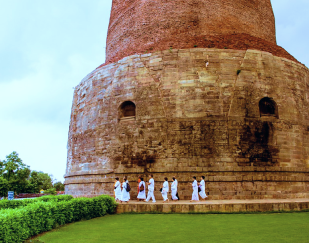
Sarnath further enriches Varanasi’s historical canvas with its Buddhist monuments, many commissioned by Emperor Ashoka. The Ashoka Pillar, crowned with the Dharmachakra that now adorns India’s national flag, commemorates the teachings of Buddha. Nearby, the Dhamekh Stupa captivates visitors with its intricate carvings of flora, fauna and human figures, while the Mughal era Chaukhandi Stupa marks Emperor Humayun’s visit to the region.
So layered is the city’s past that Mark Twain famously observed, “Banaras is older than history, older than tradition, older even than legend and looks twice as old as all of them put together.”
Best time to visit
The most elegant time to experience Varanasi is between October and March, when the weather is pleasantly cool and ideal for temple visits, heritage walks and evening rituals by the Ganga. This season also coincides with major festivals, lending the city an added aura of celebration and colour. Summers can be intensely hot, while the monsoon months bring a quieter, rain kissed charm.
Connectivity from the UAE
Varanasi is well connected to the UAE via regular flights from Dubai, Abu Dhabi and Sharjah, usually with a short stopover in Delhi or Mumbai. Direct flights to Delhi allow for seamless onward connections by air, luxury train or chauffeured drive to Varanasi, ensuring a smooth and comfortable journey.
Visa for UAE Nationals and residents
UAE nationals are eligible to apply for India’s tourist e Visa, a convenient and streamlined process for leisure travel and those who have held an Indian visa before can also avail visa on arrival at select international airports. UAE residents of other nationalities may also apply for an Indian e Visa, subject to passport eligibility. Travellers are advised to review current requirements and apply in advance for a seamless arrival experience.