• CHECK OUR REVIEWS ON
Generic selectors
Exact matches only
Search in title
Search in content
Post Type Selectors
page

Golden Triangle: A Regal Journey

Embark on a journey through time and grandeur with our India Golden Triangle Tour Package, an exquisite passage through North India’s most iconic treasures. For the discerning foreign traveller, this curated route of Delhi, Agra, and Jaipur offers an unparalleled immersion into the regal splendour of India’s storied past. Marvel at the ethereal beauty of the Taj Mahal bathed in dawn’s first light, wander through the majestic halls of the Red Fort, and admire the intricate latticework of Jaipur’s Hawa Mahal. Every monument tells a tale of emperors and artisans, woven into a tapestry of history and artistry as lavish as it is timeless.

Beyond the architecture, the Golden Triangle is a sensory celebration—where centuries-old traditions come alive through sumptuous cuisine, vibrant markets, and culturally immersive experiences. Savour royal Rajput dishes, partake in private heritage walks, or enjoy exclusive access to artisan workshops, all tailored to your tastes. At Flying Squirrel Holidays, we elevate this classic journey into a bespoke luxury experience, with private chauffeurs, expert guides and handpicked accommodations that mirror the region’s regal elegance. Let us craft your Golden Triangle adventure where history meets opulence, creating memories as magnificent as the monuments themselves.

OVERVIEW

There are myriad refined ways to glide through the Golden Triangle, each curated to mirror your sense of time, comfort and indulgence. Chauffeured luxury road journeys are increasingly coveted, granting the liberty to uncover lesser-known treasures and savour serendipitous detours. For connoisseurs of elegance infused with nostalgia, graceful train voyages link the cities effortlessly, delivering a charming yet economical passage steeped in old-world romance. For those who prize time above all, private flights between Delhi, Agra and Jaipur compress distances dramatically, ensuring every precious hour is devoted to the pleasures of discovery.

Bespoke journeys by Flying Squirrel Holidays

At Flying Squirrel Holidays, we excel in designing tailor-made Golden Triangle sojourns that echo your individual aspirations. From deeply immersive cultural encounters and privileged access to storied heritage sites, to discreetly personalised comforts, our specialists orchestrate every detail with finesse. Aptly christened the Golden Triangle for the cultural wealth and historic splendour each city embodies, this legendary circuit unveils India’s regal soul in a manner that is both seamless and unforgettable.

Best time to visit

The most rewarding season to experience the Golden Triangle is from October to March, when days are pleasantly cool and ideal for sightseeing, while evenings invite leisurely indulgence. This period also coincides with vibrant festivals and cultural celebrations, adding a layer of colour and ceremony to your journey. The summer months, from April to June, are markedly warmer, while the monsoon season between July and September brings fewer crowds and a softer, rain-washed charm.

Connectivity from the UAE

Travelling from the UAE to the Golden Triangle is effortless and well-appointed. Non-stop flights operate frequently from Dubai, Abu Dhabi and Sharjah to Delhi, the primary gateway to the route, as well as to Jaipur. Agra is conveniently reached by a short luxury drive or premium train service from Delhi or Jaipur, making onward connections smooth and unhurried for discerning travellers.

Visa for UAE Nationals and Residents

UAE nationals are eligible to apply for an Indian tourist e-Visa, a streamlined process that allows convenient entry for leisure travel. Nationals who have earlier held an Indian visa can avail visa on arrival in India. UAE residents of other nationalities can also apply for an Indian e-Visa, subject to their passport eligibility. It is advisable to review the latest requirements and apply in advance to ensure a seamless commencement to your Indian journey.

HIGHLIGHTS OF GOLDEN TRIANGLE

PLACES TO VISIT

Delhi

Most packages start at the capital city of New Delhi. The city can be divided into two extremely vibrant sets of experiences- Old Delhi and New Delhi. Old Delhi, a district within the capital city, is as teeming with heritage sites as it is with crowd and chaos. Manoeuvring against the mayhem might be challenging, but it is also memorable.

Agra

The second city on the Golden Triangle is Agra. Home to the symbol of love, wealth and power that is the Taj Mahal, the city draws countless visitors every year who stand in awe of the beautiful mausoleum.

Jaipur

The final city of the Golden Triangle route is the royal Pink City of Jaipur. Home of the valorous Rajputs, this capital city of Rajasthan has stunning, imposing palaces and fort.

THINGS TO DO

While in Delhi, one must get a taste of the local cuisine. Popular for its street food, Delhi’s Chaats, Parathas, Rolls and Kulfis are scrumptious. The city also has good fine dining options, with the restaurants of the ITC Maurya and the Marriott offering a wide range of cuisines.

Shopping in Delhi, quite like its food, has a wide range. Local handicrafts, artifacts, pottery, antique jewellery, food items, clothing, footwear- everything you want can be found in street markets like Dilli Haat and Sarojini Market. High-end brands are available at luxurious malls like DLF Emporio and Select Citywalk.

While in Agra, one must taste the world-famous Pethas, a syrupy sweet made of white pumpkin. Other street food like Bhalla, which is a savoury dish like Delhi’s Tikia Chaat, and Dal Moth, a mix of fried spicy lentils, are also popular. Mughlai cuisine is a natural extension to the years of Mughal rule over the city and can be found easily in Agra.

Be sure to pick up Agra’s famous leather products while in the city. Agra also has great marble and in-lay work collections. Head to Sardar Bazaar and Kinari Bazaar for genuine leather shoes, belts and bags and Fatehabad Road for stunning marble pieces like vases and jewellery boxes. The world-famous Agra sweets are also tourist favourites.

Jaipur’s palaces and forts are places of unmatched beauty, and quite like these imposing structures, the city’s bazaars sell handicrafts and jewellery that are otherworldly. Head to Johri Bazaar, spread near the Hawa Mahal to pick up some indulgent jewellery pieces, carved in traditional Rajasthani style.

Bapu Bazar, lying close to Johari Bazaar, is a great destination to pick up colourful Rajasthani textiles like the unique leheriya print. Mojaris, the stunning traditional footwear, can also be purchased here, along with ghagra-cholis, the traditional attire of the state.

Jaipur is a paradise for food lovers. Iconic eateries like Laxmi Mishthana Bhandar serve mouth-watering desserts of the state, like phini, ghewar, balushahi and milk cake, along with a spread of chaats and savouries.

Choki Dhani, a mock traditional village established just outside the city, serves a traditional Rajasthani course of dal-bati-churma. The famous Pyaaz Kachori, a spicy, aromatic savoury with a filling of onions, must be tried at Rawat Mishthana Bhandar.

Other delicacies of the state like til-kut, til-papdi, lassi, puchka and bharwa mirchi can be found easily all over the state.

TOP TOURIST ATTRACTIONS

Chandni Chowk

It is at the centre of Old Delhi, a bazaar filled with shops selling spices, jewellery, handicrafts, handlooms, saris inter alia.

Visit the oldest perfumery in the country, Gulab Singh Johari Mal, which has been in the business for two centuries! Paranthe Wali Gali is a favourite of every person who visits or stays in Delhi, and a trip to the city would be remiss without gorging on their eccentrically stuff parathas!

Red Fort

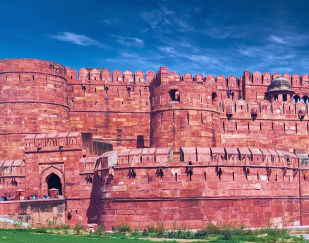
Near Chandni Chowk is the UNESCO World Heritage Site of Lal Qila, or Red Fort. The staggering fort, envisioned by the Mughal emperor Shah Jahan, is modelled on the Agra Fort.

The colossal citadel is spread over approximately 255 acres, and has seen some of the most important moments in India’s history. The home of the Peacock Throne, a lavish throne cast in gold and bearing the Koh-i-Noor, it was looted by the Persians in the mid-18th Century, following which the British captured it.

Reclaiming the fort became a symbol of India’s independence struggle, and till date, the national flag is hoisted in the Fort by the Prime Minister on Independence Day.

The fort houses a War Memorial Museum, which contains an expansive collection of weapons, tracing back to the Mughal Empire, as well as Meena Bazaar, a marketplace to buy handicrafts and souvenirs.

The living and administration quarters of the Sultanate is best explored through guided tours.

Jama Masjid

Opposite to the Red Fort is the Jama Masjid, built by Shah Jahan. With its towering minarets and bulbous domes, the mosque is an example of the Golden Age of Mughal architecture.

Jama Masjid is the largest mosque in the country, and one must be appropriately dressed to enter it. Near the Masjid is the Digambar Jain Lal Mandir, the oldest temple of the Jains in the city, which was also built under the reign of Shah Jahan.

Today, the temple houses a Bird Hospital, which is considered to be the only one of its kind in the world, which treats 15000 birds every year. Visitors frequent this temple and hospital for its peace and sanctity.

The modern, well-planned capital city that we know today was developed outside Purani Dilli. Its cosmopolitan society is reflected in its monuments, some of which are places of worship of different religions.

Along with these, the host of historical and administrative attractions are popular with visitors.

Qutub Minar

A UNESCO World Heritage Site, looms over Delhi. One of the tallest minarets in the country, it is perplexing to think how an edifice this massive could be constructed in the 12th Century, without any modern engineering methods.

The minaret is made of sandstone and marble, and features intricate carvings of verses from the Quran on its walls. It stands in the Qutub Complex, which also houses the Quwat-ul-Islam mosque, the Tombs of Allauddin Khilji and Iltutmish and the intricately detailed Alai Darwaza, which is made of sandstone and marble.

The Qutub Festival is held in the winters annually, with dancers, musicians and artists performing for three days.

Humayun Tomb

The first architecture by the Mughals in India, is a grand mausoleum which is known to be the inspiration for the Taj Mahal. Built for Humayun by his Queen, the tomb is the Indian subcontinent’s first garden tomb.

Subsequent to its construction, tombs of Humayun’s descendants were added, earning it the title of the Necropolis of the Mughal dynasty. It is a stunning construction of red sandstone, filled with intricate carvings, and is one of the most popular attractions in the city.

India Gate

It is an arch, like the Arc de Triomphe in Paris, which was established as a tribute to the soldiers who lost the Afghan War in 1919, whose names have been inscribed in its walls.

The stunning archway is made of red sandstone from Bharatpur, and is made even more ethereal at night with soft, glowing lights. The Amar Jawan Jyoti, a marble construction, was set up opposite the India Gate to honour the martyrs of the Indo-Pak War of 1971.

The lovely boulevard of Rajpath, which runs from the Rashtrapati Bhawan and leads up to the National Stadium, passes through the India Gate. The avenue is lined with bright green trees, and lawns surround the Gate, making the entire area a sight for sore eyes. Visitors and locals alike love to enjoy picnics here.

The Lotus Temple

With its stunning architecture, is one of the most visited monuments in the world. Shaped like a 27 petalled lotus, the nine pools of water surrounding it make it a mesmerising sight.

A Bahai place of worship, it is built on the idea of the unity of the human race, and people from all religions can enter and pray as they wish here. The Akshardham Temple is another marvellous place to visit in the city.

Dedicated to Lord Swaminarayan, the temple is surrounded by 60 acres of the lush Garden of India, and features a musical fountain, exhibition on the life of Swaminarayan, and the ideals of the sect.

A visit to Akshardham is a must for every visitor, whether a believer or not.

Taj Mahal

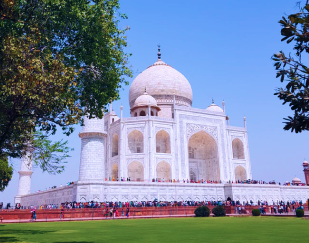
The luminous white marble of the Taj Mahal effortlessly mirrors the shifting palette of the sky, inviting you to linger and soak in its enchanting splendour. At dawn, it blushes with a delicate pink glow, while under the moonlight, it transforms into a radiant, sparkling vision, truly a masterpiece of ethereal beauty.

For the privileged few, access to the Taj Mahal’s grounds during five select nights each lunar month, offer an exclusive, breathtaking experience few ever witness. To fully appreciate the intricate artistry and hidden stories within the Mahal’s interiors, a private guided tour is highly recommended, ensuring a deeper connection with this timeless symbol of love and grandeur.

Mehtab Garden

It is the last remaining of the eleven gardens built by Babur, and it is a splendid place filled with fresh and bright trees. Also called the Moonlit Gardens, it offers panoramic views of the Taj Mahal from a distance, allowing one to appreciate the symmetry of the mausoleum.

Agra Fort

Another place to visit in Agra is the Agra Fort, which served as a model for Delhi’s Red Fort. The Agra Fort used to be the seat of the Mughal empire before Shah Jahan shifted the capital to present-day Delhi, and exploring the fort takes a good three hours.

There are light and sound shows held every evening, and it is a good way to learn about the history of the fort.

Hawa Mahal

The massive red and pink sandstone structure of the Hawa Mahal dominates the city of Jaipur. The exterior of the palace is filled with small jharokha windows, which makes the edifice resemble a honeycomb from the streets, giving it its iconic facade.

The small windows make sure that the palace stays breezy at all times, and hence it is named ‘The Palace of Wind’. The confluence of Rajputana and Mughal architectural elements is evident in the Hawa Mahal, with canopies and lotus motifs representing the former, and marble inlay work borrowed from the latter.

City Palace

One of the premier highlights of the city is the City Palace. The residence of the Kachwaha Rajputs throughout their rule, the palace is overflowing with grandness and beauty.

The inner courtyard of the palace is home to the Ridhi Sidhi Pol, a group of four spellbindingly aesthetic gates, decorated with motifs representing the four seasons and dedicated to Hindu deities.

The Lotus Pol has lovely floral detailing, and represents summer. Dedicated to Lord Shiva and Goddess Parvati, the vibrant colours on the door are impressive. The most famous of the four gates is the Peacock Gate, dedicated to Lord Vishnu, with stunning engravings of the majestic bird.

This gate represents autumn. The third gate, depicting winter and made in honour of Goddess Devi, is the Rose Gate. The paintings of delicate rose petals are gorgeous. The final gate in the series is the Lehariya Gate, for spring, dedicated to Lord Ganesh. The gate is marvellous, with bright green waves decorating it.

Mubarak Mahal within the palace houses an extraordinary collection of textiles from the Royal Family, and the exhibition is admirable.

Chandra Mahal, the residence of the Maharaja of Jaipur, is a staggering seven storey palace beyond the Riddhi Siddhi Pol, and the first floor has been converted to a museum displaying the cultural heritage of the Rajputs, and is accessible to the public.

The premise also houses a Clock Tower, a Diwan-e-aam and a Diwan-e-khaas, all decorated with stunning murals.

Nahargarh Fort

Another imposing fort in the city is the Nahargarh Fort, which was built as a defensive fort. A temple worshipping the monarchs of Jaipur stands in the fort, along with another one dedicated solely to Prince Nahar Singh Bhomia, whose spirit was thought to have haunted the premises.

Madhavendra Bhawan, made in honour of Sawai Madho Singh, the ruler who envisioned the fort, holds 12 identical sculptures of the 12 queens of the king, and draws a number of tourists. Perched atop the Aravali hills, the fort offers breath-taking views of Jaipur.

Amer Fort

One of the most exquisite Hill Forts in Rajasthan is the Amer Fort. The sprawling marble and sandstone structure is immensely well-loved by tourists, who are left awestruck by its quaint beauty.

Standing on the hilltop called Cheel ka Teela, meaning the hill of eagles, the palace overlooks the Maota Lake. The detailing on the palace walls are of organic colours, which have stood the test of time and are still bright and vibrant.

It is said that real gold was used to further beautify these murals. The Sheesh Mahal, or the Hall of Mirrors, is one of the biggest attractions in the palace, and visitors are left spellbound by the reflections of the small mirrors that line the ceiling.

    Request For a free quote

    ITINERARY

    (Please note that the following are sample itineraries. Flying Squirrel Holidays works with your requirements to tailor make your dream Golden Triangle Tour itinerary for you)

    Golden Triangle Tour Package by Car: 5 Days, 4 Nights

    Resplendent Golden Triangle: 9 Days, 10 Nights

    Week in Golden Triangle:  7 Days, 6 Nights

    Golden Triangle Tour Package by Car (This is only a sample itinerary)

    DAY 1

    Arrive in Delhi, and transfer to the hotel. Spend the day leisurely exploring Humayun's Tomb and Red Fort. After a hearty dinner at the hotel, retire for the night.

    DAY 2

    Following breakfast, leave for a tour of the highlights of the capital- Raj Ghat, Jama Masjid, Qutub Minar and India Gate. After lunch, spend a peaceful afternoon in the Lotus Temple, and visit the Akshardham towards the evening. Head back to the hotel for dinner.

    DAY 3

    After a light breakfast, leave for Agra by road, which takes a little under four hours. Spend the day exploring the Taj Mahal. Retire to bed early after dinner.

    DAY 4

    Following breakfast, we head to Jaipur via road, which will take around four hours. Make a stop at Fatehpur Sikri on the way to explore the erstwhile capital of the Mughal Empire. After checking into the hotel in Jaipur, visit the City Palace and the Hawa Mahal, and spend the evening at the vibrant bazaars. Dinner at the hotel.

    DAY 5

    The last day of the trip begins with breakfast at the hotel. Head to Amer Fort after breakfast, and explore the stunning palace. Head to the airport after lunch to catch your flight back home.

    Please email me a copy of the sample itinerary

    FAQ

    1. Which cities are included in the Golden Triangle in India?

    The Golden Triangle tour comprises three cities namely Delhi, Agra, and Jaipur.

    2. Is Golden Triangle in India worth seeing?

    Golden Triangle consists of all the popular destinations with unique beauty and charm. Therefore, it’s worth exploring the destinations to have a memorable experience.

    3. What is a good time to visit the Golden Triangle in India?

    October to mid-April is considered as the best time to visit the Golden Triangle in India.

    4. How do I plan a Golden Triangle tour in India?

    To plan a hassle-free Golden Triangle tour, you can get in touch with us. We can help you customise your holiday according to your tastes and preferences.

    5. How long do you need to visit the Golden Triangle of India?

    A minimum of 7-8 days tour is recommended to visit the Golden Triangle of India.

    Golden Triangle Tours are a great way to soak in the history of North India, particularly the Rajputana and Mughal chapters. Dotted with heritage sites, forts and palaces that are stunning, exploring this route will leave you in awe of the diverse culture that makes India the Land of Colours it is today. Do not forget to do some shopping and eat some of the most scrumptious food in the country while on this route.

    Got a Question? We'll Gladly Help

    Join our mailing list to receive the latest updates and freshest offers!

      connect with us at +97152 267 4399

      or write to us at connect@flyingsquirrelholidays.com